Esther Jane Telfer
Biography
Role: Daughter of Francis Telfer — matriarch of the Smith line
Born: 21 May 1834 — Isle of Skye, Scotland
Died: 12 March 1909 (aged 75) — Nyngan, New South Wales
Buried: Nyngan Cemetery (Church of England section)
Spouse: John Smith (~1827 – 5 May 1895)
Ship: Prince George — arrived Port Adelaide 26 December 1838 (aged 4)
Photo
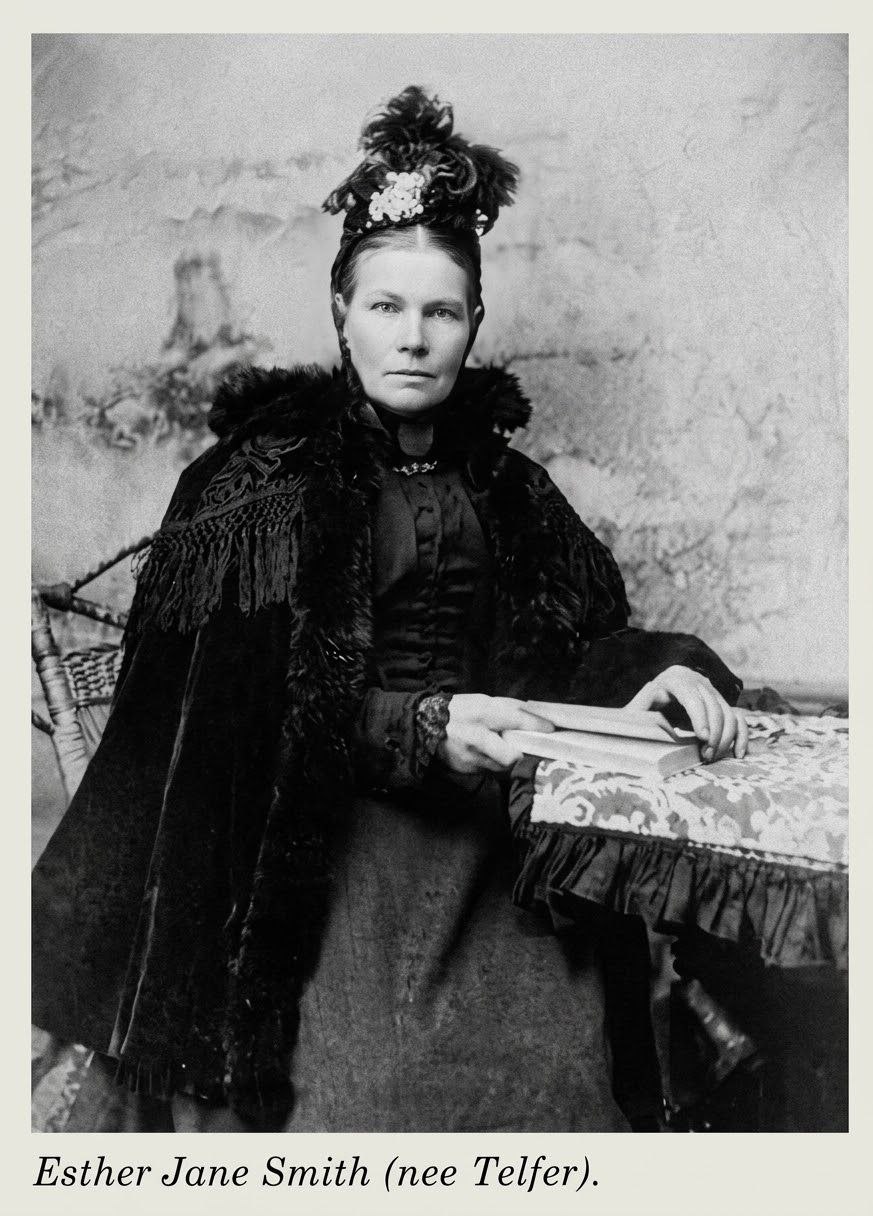
Esther Jane Smith (née Telfer) — formal studio portrait, likely late 1880s–early 1900s. She is seated in a dignified pose, dark high-necked gown with lace cuffs, a beaded necklace, and a rich fur-trimmed cape with fringed edging. Her hair is swept up in an elaborate chignon with small floral/beaded adornments. Hands rest over a book on a small draped side table against a painted studio backdrop. Captioned "Esther Jane Smith (nee Telfer)." (photograph supplied by Mark Telfer; date of portrait not recorded)
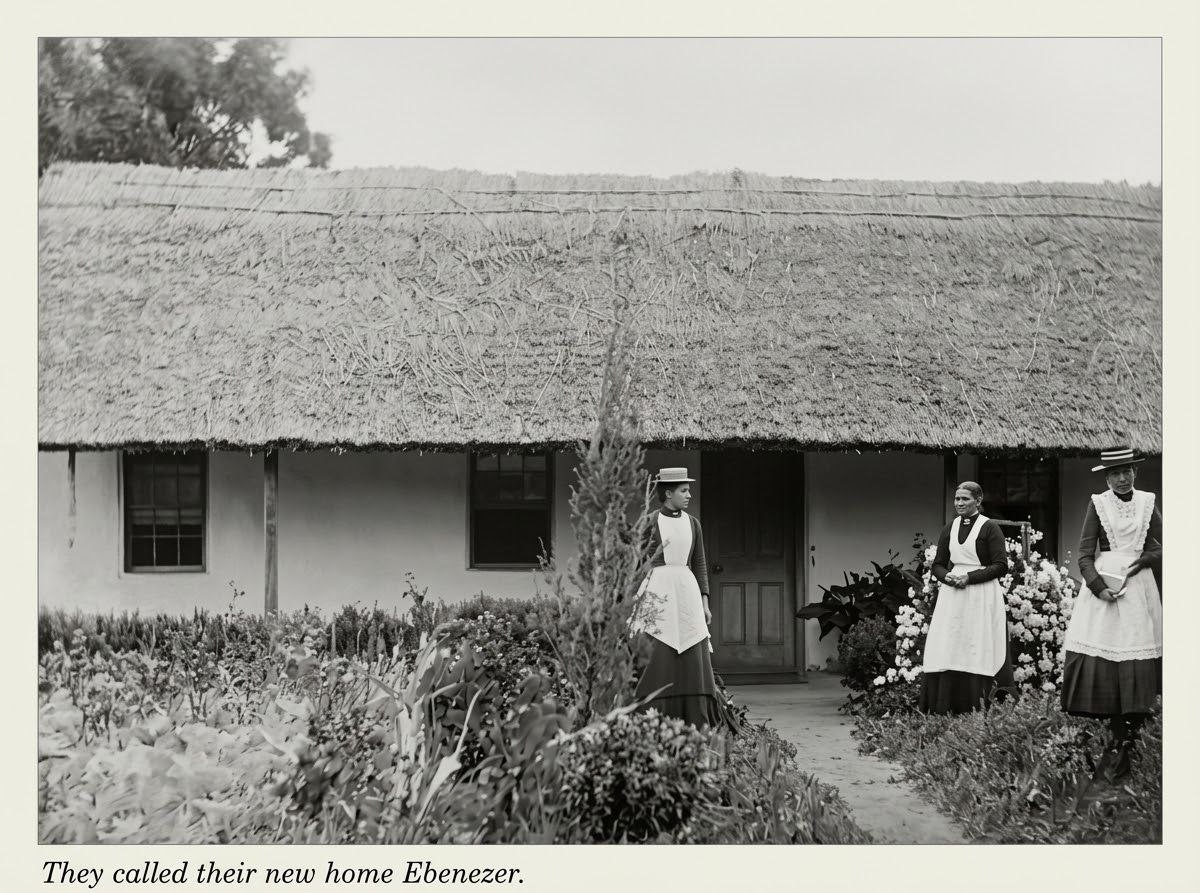
Their new home "Ebenezer" — the John Smith family farm at Sherwood Dam near Mount Arapiles, Natimuk, Victoria (c. 1878–1889). A pug-and-thatch construction named "Ebenezer." The three women in the garden are not named in the source caption; the dress (dark gowns, white aprons, straw boaters) is typical 1890s–1900s farmwear. The children attended Arapiles School. Book caption: "They called their new home Ebenezer." (From the Borders to the Bush, p.35; photograph supplied by Mark Telfer)
Family
| Relation | Name |
|---|---|
| Father | Francis Telfer (1809–1895) |
| Mother | Jean Murray (1810–1839) |
| Husband | John Smith |
Children
| Child | Born | Died | Married |
|---|---|---|---|
| Jane Sophie Smith | South Australia | Apr 1913 (aged 47) | Benjamin Harper |
| Margaret Dougal Smith | Burra, S.A. | 30 Oct 1961 (aged ~93) | Thomas Parkins |
| Esther Telfer Smith | 27 Sep 1870, Tungkillo S.A. | 5 May 1896 (aged 25) | Thomas Henry Kent |
| John James "Jack" Smith | 1871, Tungkillo S.A. | — | Idona Caston Murray |
| Francis Telfer "Frank" Smith | 14 Feb 1874, Mt Gambier S.A. | 9 Jul 1945, Nyngan | Ellie Forbes, Catherine Gibson |
| Elizabeth Anne Smith | 1878, Millicent S.A. | — | — |
Life Summary
Early Life
Esther was born on the Isle of Skye to Francis Telfer and Jean Murray — the second of their three children. When she was four, the family sailed for South Australia aboard the Prince George, arriving at Port Adelaide on 26 December 1838. Her mother Jean died at the Emigration Depot barely a month after landing.
Esther grew up at Chain of Ponds in the Adelaide Hills, then Kersbrook, where her father Francis farmed and helped establish the Church of Christ.
Marriage to John Smith
On 16 November 1864 at the Wesleyan Parsonage, Kapunda, Esther married John Smith — a man born in Copenhagen, Denmark in 1830, son of a Scottish Sea Captain and a Danish mother. John had bought a block of land on Gunningbah Creek, north of Nyngan, running sheep. Together they had six children.
The Move to Victoria
The family set out for Victoria, but Esther, pregnant with her sixth child, found the journey by horse-drawn wagon with steel-rimmed wheels on dirt roads too much. She stayed in Millicent (South East) until after Elizabeth Anne was born in 1878, while John and some of the children pushed on to Natimuk, Victoria to set up a new home.
Their new home, called "Ebenezer", was a pug-and-thatch construction at Sherwood Dam near Mount Arapiles. The children attended Arapiles School.
The Trek to Nyngan
Towards the end of the 1880s, the two oldest boys — John James and Francis Telfer — rode pushbikes some 600 miles into the outback to Nyngan to scout land. They came back with glowing reports.
The family sold their Natimuk farm to the Lange family and set out on a weeks-long trek to Nyngan in a wagon drawn by four draught horses. Their diet: damper cooked in camp ovens, corned meat, and whatever rabbits and birds they caught along the way. Water bags hung from the side of the wagon in the shade to keep cool.
John bought the block on Gunningbah Creek and ran sheep there until his death on 5 May 1895.
Later Life
After John died, Esther moved into Nyngan township — a brick home in Wambiana Street. She was described as a tiny person, just five feet tall, a devoted mother and grandmother, and a loyal church supporter.
Her home was still standing in good condition as of 1984.
She died on 12 March 1909, aged 75, and was buried with her husband in Nyngan Cemetery.
Family Stories
The Bike Scouts
In the late 1880s, Esther's two boys — John James (about 17) and Francis Telfer (about 15) — rode pushbikes nearly 600 miles from Natimuk, Victoria into the wilds of outback New South Wales to scout land. They returned full of talk about Nyngan and the land opening up. It was their report that convinced the family to pull up roots and make the long trek north.
(From the Borders to the Bush, pp.39–40)
Essie Ray — Esther's Granddaughter
Essie (Esther Jane Harper, granddaughter through Jane Sophie) grew up walking 2.5 miles to school, milking a cow before she left. At about age 11, her family moved from Miram, Victoria to Mullengudgery, NSW. Her mother died of pneumonia about three years later. At just 14, she kept house for six children in a big house with board floors she scrubbed weekly on hands and knees, made butter, did all the cooking, and looked after the lot.
Her brother rode a bike 27 miles into Nyngan to get the doctor — there were no telephones. Too late.
She later married Alex Stevenson (a "nice chap"), had two children. Alex died in his 30th year. She supported herself by dressmaking. Married second to Robert Ray, a widower with two grown daughters. Learned to drive a truck to take fruit from their orchard to the railway.
She celebrated her 90th birthday on 4 January 1989 and still attended Presbyterian Church and Guild, and had a life membership badge from the Orange Show.
(From the Borders to the Bush, pp.40–41)
The Promise to a Dying Sister
Esther's namesake daughter, Esther Telfer Smith, married a Wesleyan minister named Thomas Henry Kent. Thomas died of consumption on 17 December 1895 — just eight months after their wedding. The younger Esther followed him to the grave five months later, also from consumption, on 5 May 1896.
On her deathbed, she asked her sister Margaret: "If you ever go to Melbourne, will you visit Thomas's grave?"
Forty-six years later, Margaret — then a widow herself — visited her daughter Ruby and son-in-law Roy Pearce at Bendigo. Roy drove her to Melbourne, and she fulfilled her sister's dying wish.
(From the Borders to the Bush, pp.44–45)
The Eudora Merino Stud
Esther's youngest son, Francis Telfer Smith, drew a block at Mullengudgery (27 miles out of Nyngan) in 1898 and named it "Eudora". He built a large weatherboard home surrounded by shade trees, a big garden with stone fruits and citrus, and a tennis court. He established the Eudora Merino Stud and took sheep to the Royal Sydney Show.
He was a keen pushbike rider in his youth — once rode from Eudora all the way to Mount Gambier with two friends. He also owned racehorses: "Pearl George" and "Pharalie" were sold and shipped to India during WWI.
His daughter Ena recalled: no refrigeration — a charcoal safe with a troublesome door and a green frog living in the water tray on top. Canvas water bags hanging on the verandah. Round galvanised tubs for bathing — knees under chin or legs over the side. Their first car was a T Model Ford; summer nights with the hood down, chugging along at about 20 mph.
When the 1955 flood hit the Bogon River, the Dubbo Aero Club dropped food parcels that burst hitting the water. The family fished tins out of two feet of floodwater — labels lost. They opened cat food for lunch once without realising.
(From the Borders to the Bush, pp.47–57)
Jack Smith Saves Melrose
Esther's oldest son John James "Jack" Smith lived at "Brooklands" on Duck Creek and ran a Merino stud. When his sister Margaret Parkins' husband Thomas was killed in a sulky accident in 1917, Margaret struggled to keep their property "Melrose" going. Her son Dougal hit bad seasons and couldn't make ends meet. The bank threatened to foreclose.
Jack walked into the bank, threw his cheque book on the manager's desk, and said: "Take what you want out of that, but don't you dare put Margaret Parkins — a widow — out of Melrose."
Melrose stayed in the Parkins family for 61 years.
(From the Borders to the Bush, pp.44, 46)
Sources
- Note: WikiTree lists husband as "Hans Hansen (Jorgenson) Smith" — "Hans" is the Danish equivalent of "John". The book From the Borders to the Bush confirms he was born in Copenhagen, son of a Scottish Sea Captain and Danish mother, consistent with anglicising his name to John Smith in Australia.
- Source: Donald Telfer, From the Borders to the Bush (ISBN 0 7316 6387 X), pp. 36–57 — extract via OCR and vision analysis 19 June 2026
- FindAGrave: Esther Smith (1836–1909) — Nyngan General Cemetery, "w/John; mother" — d. 12 Mar 1909 — accessed 24 Aug 2026 (corrected from memorial 252916720, which resolves to Ann Haywood (1842–1917), a different person) + WikiTree Telfer-591 — d. 1909-03-12 Nyngan — 2 independent source groups confirm death date 12 Mar 1909
- Source (marriage correction): South Australian Register (Adelaide, SA : 1839–1900), 26 Nov 1864, Family Notices — "SMITH—TELFER ... 16th November, Wesleyan Parsonage Kapunda ... to Esther, eldest daughter of Mr. Francis Telfer" — Trove article 39119344 — accessed 11 Aug 2026
- WikiTree: Esther Jane Telfer (Smith) (1834–1909)
Tags
Spouse
- John Smith (1827 – 1895)
Parents
- Francis Telfer (1809 – 1895)
- Jean Murray (1810 – 1839)
Children
- Elizabeth Anne Smith (1878 – ?)
- Esther Telfer Smith (1870 – 1896)
- Francis Telfer Smith (1874 – 1945)
- Jane Sophie Smith (? – ?)
- John James Smith (1871 – ?)
- Margaret Dougal Smith (1868 – 1961)
Siblings
- Elizabeth Hannah Telfer (1836 – 1916)
- George Telfer (1850 – 1913)
- James Telfer (1832 – 1845)